The Future of Artificial Intelligence Technology
AI TECHNOLOGY 20 JAN 2026
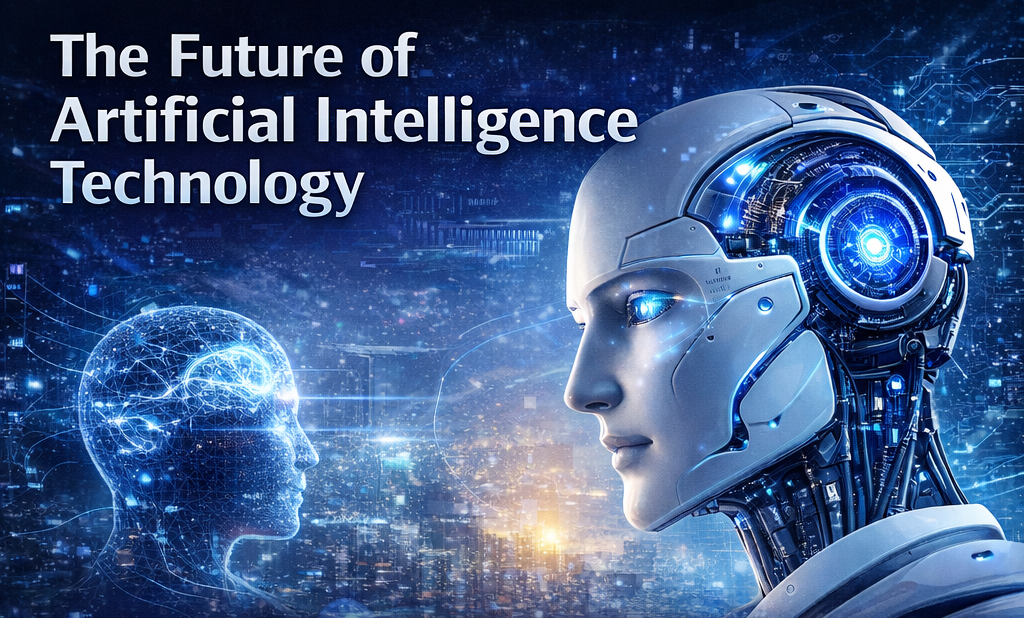
Artificial Intelligence (AI) is one of the most powerful technological innovations of the modern digital era. It enables machines to simulate human intelligence, analyze massive datasets, recognize patterns, and make smart decisions faster than ever before. From healthcare and finance to education, transportation, and global business automation, AI technology is transforming how industries operate worldwide. Organizations are rapidly adopting AI solutions to improve productivity, reduce operational costs, enhance decision-making accuracy, and deliver highly personalized digital experiences to customers.
📚 Evolution of Artificial Intelligence Technology
Artificial Intelligence began as a research concept in the mid-20th century but has rapidly evolved into one of the most impactful technologies shaping modern society. Early AI systems focused mainly on rule-based automation, but today’s intelligent algorithms use machine learning, deep learning, and neural networks to solve highly complex problems. With the advancement of cloud computing, big data analytics, and high-performance processors, AI is now capable of supporting real-time decision making across industries.
🚀 AI Technology – Transforming the Digital World
Artificial Intelligence technology allows organizations to automate workflows, detect hidden insights within large datasets, and improve operational efficiency through intelligent systems. Businesses across the globe are leveraging AI-powered platforms to enhance customer engagement, improve supply chain management, strengthen cybersecurity infrastructure, and accelerate innovation in digital transformation strategies.
🔬 Power of AI Research & Innovation
Continuous research in Artificial Intelligence is driving the development of smarter algorithms capable of solving complex challenges in healthcare diagnostics, financial forecasting, environmental monitoring, and smart city infrastructure planning. Leading global technology companies are investing billions of dollars annually into AI research to accelerate innovation.
- Machine Learning & Deep Learning advancements
- Natural Language Processing for human-like communication systems
- Computer Vision for smart surveillance and recognition technology
- AI-powered Robotics for industrial automation
- Predictive Analytics for intelligent business forecasting
👨💻 AI Experts & Multidisciplinary Teams
Artificial Intelligence innovation depends on collaboration between experts from multiple technical disciplines. These specialists design scalable AI architectures capable of supporting enterprise-level digital infrastructure and next-generation intelligent applications.
- Data Scientists analyzing large datasets
- AI Engineers designing intelligent algorithms
- Software Developers building scalable AI platforms
- Cloud Architects managing AI infrastructure
- Cybersecurity Experts ensuring data protection
🏢 AI Technology Applications Across Industries
Artificial Intelligence is transforming multiple industries by enabling intelligent automation, improving accuracy, and delivering faster decision-making capabilities. Organizations worldwide are adopting AI solutions to remain competitive in the digital economy.
- Healthcare diagnosis and precision treatment planning
- Autonomous vehicles powered by AI navigation systems
- Smart assistants such as ChatGPT and Alexa
- Fraud detection and financial risk management
- Personalized education powered by adaptive learning systems
- Retail recommendation engines improving customer experience
🌍 Benefits of Artificial Intelligence Technology
- Improves business productivity and efficiency
- Reduces operational costs through automation
- Enhances cybersecurity protection systems
- Supports smarter decision-making using predictive analytics
- Provides personalized customer experiences
- Accelerates innovation across industries
⚠️ Challenges in AI Technology Development
Despite its advantages, Artificial Intelligence also presents challenges such as data privacy concerns, ethical considerations, workforce transformation, and infrastructure requirements. Organizations must adopt responsible AI strategies to ensure secure and transparent implementation of intelligent systems.
📈 Future of Artificial Intelligence Technology
The future of Artificial Intelligence is expected to revolutionize smart cities, healthcare innovation, autonomous transportation, financial intelligence platforms, and global digital communication systems. AI-powered solutions will continue shaping the next generation of intelligent automation technologies.
- AI-powered workflow automation
- Smart recommendation engines
- Virtual assistants and intelligent chatbots
- Cloud-based AI platforms
- Human-AI collaboration systems
✨ Final Thoughts
Artificial Intelligence is shaping the future of global innovation and digital transformation. Organizations that invest in AI today are positioning themselves as leaders of tomorrow’s intelligent economy. As AI continues to evolve rapidly, its impact on healthcare, finance, education, transportation, cybersecurity, and smart city development will expand significantly in the coming years.